Complete Guide
Formative Assessment: The Complete
Guide for Higher Education
What it is, why the research is so compelling, how it works in practice, and
why scale is the problem that institutions still have not solved.
Eduface
·
18 min read
·
Updated May 2026
What is formative assessment?
Formative assessment is the ongoing process of gathering evidence of student
learning during instruction, and using that evidence to adjust teaching and provide
feedback that helps students improve. Unlike summative assessment, which measures
learning after the fact, formative assessment shapes learning while it is still happening.
Research by Black and Wiliam (1998) identified effect sizes of 0.4 to 0.7 across 580
studies, making it one of the most evidence-backed interventions in education.
What is formative assessment?
Formative assessment is any assessment activity whose primary purpose is to improve
learning rather than to certify or grade it. The word comes from the Latin formare, meaning
to shape or form. That etymology captures the idea precisely: the function of formative
assessment is to shape learning while it is still in progress, not to measure it after it has
finished.
The most widely used definition in academic literature comes from Black and Wiliam's
landmark 1998 review: formative assessment encompasses all those activities undertaken
by teachers, and by students in assessing themselves, which provide information to be
used as feedback to modify the teaching and learning activities in which they are
engaged.
1
That definition contains three essential elements. First, information must be gathered about
where learning currently stands. Second, that information must be compared against
where learning needs to be. Third, action must follow from the gap. Without that third step,
the first two are data collection, not formative assessment.
Dylan Wiliam, one of the field's leading researchers, frames it this way: "Assessment is,
indeed, the bridge between teaching and learning." The goal is not just to check whether
students understood, but to use that information to shape what happens next, whether by
the teacher adjusting their approach, the student adjusting their strategy, or both.
The Formative Assessment Cycle
Learning
Improves
Where are
students now?
Where do they
need to be?
What action
closes the gap?
Gather
evidence
Teacher adjusts
Student reflects
Peers respond
Figure 1: The formative assessment cycle. Effective formative assessment requires all four stages: establishing where
students are, comparing against where they need to be, gathering evidence, and taking action. Without the action
stage, the process produces data rather than learning improvement.
Where did the concept come from?
The term "formative evaluation" was first used by Michael Scriven in 1967 to distinguish
evaluation conducted during programme development (intended to improve the
programme) from summative evaluation conducted after it was complete (intended to
judge its overall merit). Benjamin Bloom adopted the term for assessment in his 1969 work
on mastery learning, applying it to the idea of checking student understanding during
instruction rather than only at the end.
The concept gained traction in schools throughout the 1970s and 1980s, but it was Black
and Wiliam's 1998 review that gave formative assessment its current prominence. Their
systematic analysis of over 580 research articles produced effect size estimates of 0.4 to
0.7, placing formative assessment among the most powerful educational interventions
available.
1
The finding that the greatest gains were seen in lower-achieving students added
a powerful equity argument to the academic case.
Since then, the field has deepened considerably. John Hattie's Visible Learning synthesis
(2008) analysed more than 800 meta-analyses and placed feedback at an effect size of
0.73, well above his threshold of 0.40 for desired effects.
2
Nicol and Macfarlane-Dick
(2006) reframed formative assessment not as something done to students but as a
process through which students learn to regulate their own learning, positioning it as a
foundational skill for lifelong professional development.
3
What does the evidence actually say about formative assessment?
The evidence base for formative assessment is unusually strong compared with most
educational interventions. The key findings from the major reviews are worth stating
clearly, because they are sometimes cited loosely.
0.4–0.7
Effect size range: Black &
Wiliam (1998), across 580
studies
0.73
Effect size for feedback:
Hattie's Visible Learning
(2008), 800+ meta-analyses
8 months
Extra learning per year: Dylan
Wiliam's KMOFA project (0.3
SD gain)
An effect size of 0.4 is Hattie's threshold for what he calls the "zone of desired effects."
Most educational reforms, including class size reduction and many technology
interventions, fall below this threshold. Formative assessment comfortably exceeds it, and
some implementations reach 0.7, placing it in the same range as expert tutoring.
Black and Wiliam also found that formative assessment benefits low-achieving students
disproportionately.
1
This is significant for equity: interventions that raise average
performance without narrowing the gap are less valuable than those that do both.
Formative assessment does both.
Dylan Wiliam's King's-Medway-Oxfordshire Formative Assessment Project (KMOFA) tested
the impact of training teachers in formative assessment techniques and found an average
gain of 0.3 standard deviations. Translated into learning time, that is approximately eight
months of additional progress per year for students in those classrooms.
Effect Sizes: Selected Educational Interventions
Hattie's Visible Learning synthesis (2008). Threshold for desired effects: d = 0.40
0.73 Feedback
0.48 Formative assessment
0.57 Mastery learning
0.55 Peer tutoring
0.69 Metacognitive strategies
0.21 Class size reduction
d = 0.40 threshold
0
1.0
Figure 2: Effect sizes for selected educational interventions from Hattie's Visible Learning (2008). Feedback (d=0.73)
and formative assessment (d=0.48) both exceed Hattie's threshold of d=0.40 for "desired effects." Class size
reduction (d=0.21), a more commonly funded intervention, falls well below it.
What is the difference between formative and summative assessment?
The distinction between formative and summative assessment is one of purpose, not of
instrument. The same quiz can function formatively (if the results are used to identify gaps
and adjust teaching) or summatively (if the results are used only to calculate a grade).
What makes assessment formative is not its format but what happens to the information it
produces.
Carless (2006) makes this point clearly: assessment becomes formative only when it is
used as feedback that the student can act on.
4
A written comment that arrives after the
course has ended, or that is too vague to guide revision, is not functioning as formative
assessment regardless of when it was given.
Dimension
Formative assessment
Summative assessment
Purpose
To improve learning while it is in
progress
To certify or evaluate learning at the
end of a period
Timing
During the learning process,
repeatedly
At the end of a unit, module, or
programme
Audience for
results
Student and teacher, in time to
act
Institution, student, and external
stakeholders
Stakes
Low or no stakes; not normally
included in final grade
High stakes; determines grades,
progression, qualifications
Frequency
Continuous or frequent
Periodic, typically once or twice per
module
Type of
feedback
Specific, actionable, criterion-
referenced
Overall judgement, grade, or mark
with limited comment
Who benefits
most
Students who are struggling or
below target
Students who need certified
evidence of achievement
In practice, most institutions rely heavily on summative assessment and use formative
assessment inconsistently or at low frequency. This is one reason why NSS scores in the
Assessment and Feedback category remain persistently low. Students who experience
assessment primarily as a grading exercise rather than a learning tool are less satisfied
with the process and less likely to develop as self-regulated learners.
What are the seven principles of good formative feedback?
Nicol and Macfarlane-Dick (2006) synthesised the research on formative assessment and
self-regulated learning into seven principles of good feedback practice.
3
Their paper has
been cited more than 3,000 times and remains the most widely referenced framework in
higher education assessment design. Each principle addresses a specific failure mode in
conventional assessment practice.
1
Helps clarify what good performance is
Students need to understand the goals and criteria of assessment before they can aim for
them. Sharing rubrics and exemplars in advance, rather than after marking, fulfils this principle.
2
Facilitates the development of self-assessment
Students who can evaluate their own work accurately are more effective learners. Formative
activities that build this skill explicitly outperform those that treat students as passive recipients
of judgements.
3
Delivers high quality information to students about their learning
Feedback should be specific, criterion-referenced, and actionable. Comments like 'good
analysis' or 'needs more development' do not meet this standard.
4
Encourages teacher and peer dialogue around learning
Feedback that opens a conversation is more effective than feedback that closes one. This
principle supports the case for peer review, group critique, and feedback sessions over written
comments alone.
5
Encourages positive motivational beliefs and self-esteem
Feedback focused on the work rather than the student's ability is more likely to produce effort
and persistence. Comparative feedback (ranking students against each other) typically
undermines this principle.
6
Provides opportunities to close the gap between current and desired performance
Feedback given after a module is complete cannot be acted on. The timing of formative
assessment is as important as its content. Students must have the opportunity to apply what
they have learned from feedback.
7
Provides information to teachers that can be used to help shape their teaching
Formative assessment is not only for students. When lecturers use assessment data to identify
where a cohort is struggling, they can adjust their teaching before the summative assessment
arrives.
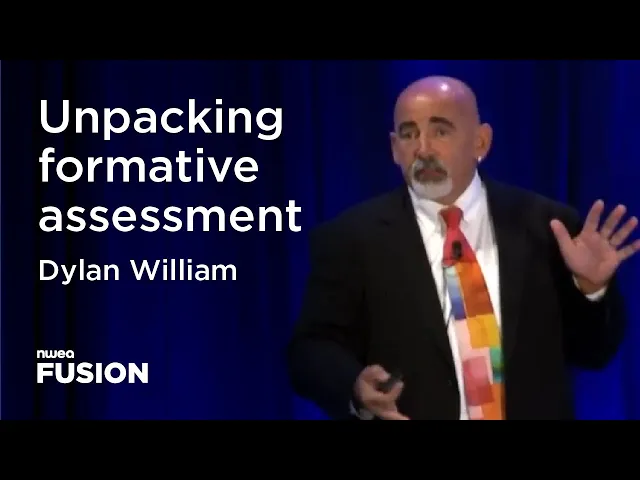
Dylan Wiliam on Formative Assessment
youtube.com/watch?v=kPf0nQFfv50
Professor Dylan Wiliam (University College London) unpacks the core principles and strategies of formative assessment.
What are the main types of formative assessment?
Formative assessment encompasses a wide range of activities. The specific format matters
less than whether the activity generates usable evidence of learning and triggers a
response. In higher education, the most commonly used approaches fall into four broad
categories.
Questioning and classroom dialogue
High-quality questioning in lectures or seminars generates immediate evidence of what
students do and do not understand. This includes targeted verbal questions, think-pair-
share activities, and anonymous digital polling (using tools such as Mentimeter or Poll
Everywhere). The key is that questions are designed to elicit reasoning, not just recall, so
that both the lecturer and the student can identify gaps in understanding in the moment.
Short written tasks and quizzes
Low-stakes written tasks, including ungraded quizzes, short-answer questions, reflective
writing prompts, and exit tickets, generate evidence that can be reviewed by the lecturer
before the next session. Research on the testing effect consistently shows that the act of
retrieval (trying to recall information) strengthens memory more than re-reading does.
5
When these tasks are ungraded, students are more likely to engage honestly rather than
strategically.
Peer and self-assessment
Structured peer assessment, where students evaluate each other's work against shared
criteria, is one of the most extensively researched forms of formative assessment in higher
education. Falchikov and Goldfinch (2000) found that when criteria are clear and students
are given guidance on how to apply them, peer marks correlate reasonably well with
lecturer marks.
6
The benefit extends beyond the accuracy of the grade: the process of
evaluating another student's work deepens the evaluator's own understanding of the
criteria.
Draft submission and feedback cycles
Asking students to submit a draft of an essay, report, or project before the final submission
creates a structured opportunity for formative feedback. The feedback must be specific
and actionable, and students must have time to revise, or the cycle does not close. This
approach directly addresses NSS question concerns about feedback being received too
late to influence performance.
How does formative assessment work in higher education?
Higher education presents distinctive challenges for formative assessment that do not
apply in the same way in schools. Cohort sizes are larger, often ranging from 100 to 400
students in a single module. Contact time is more concentrated: students may see a
lecturer for two to four hours per week rather than five hours per day. The relationship
between lecturer and student is less continuous, making it harder to track individual
progress over time.
Despite these challenges, the evidence for formative assessment's impact holds in higher
education contexts. Weaver (2006) found that students in higher education consistently
value detailed, criterion-referenced written feedback above grades, but that they rarely
receive it at sufficient frequency or quality.
7
The gap between what students want from
feedback and what they actually receive is one of the most consistent findings in UK higher
education research, and it is reflected directly in NSS Assessment and Feedback scores
year after year.
The five NSS Assessment and Feedback questions cover: whether students understood
what was expected of them, whether assessment criteria were made clear, whether
feedback was useful in clarifying things not understood, whether feedback was received in
time to inform subsequent work, and whether the assessment and marking was fair. Each
of these questions maps directly onto the failure modes that formative assessment practice
is designed to address.
NSS link: Assessment and Feedback is the lowest-scoring category in the National
Student Survey every year. The five questions in this category (criteria clarity,
feedback usefulness, feedback timeliness, understanding performance, and
fairness) each correspond to a principle of good formative assessment practice.
Institutions that systematically improve formative assessment see measurable
improvement in NSS scores in this category.
Why is scaling formative assessment the unsolved problem for most
institutions?
The research case for formative assessment is not in dispute. The implementation gap is.
Most institutions that have genuinely engaged with the evidence agree that more formative
feedback, given more frequently, with greater specificity, would improve student learning
and NSS outcomes. The barrier is not intention. It is time.
The University and College Union's 2016 workload survey found that 26% of UK higher
education staff work more than 50 hours per week, that 75% describe their job as stressful,
and that 46% report unrealistic time pressures as a chronic feature of their role.
8
Marking
and feedback account for a significant share of that workload, particularly in modules with
high volumes of written assessment.
The arithmetic is unfavourable. A lecturer with 120 students who spends 25 minutes per
student on formative feedback is committing 50 hours of time per assessment cycle,
before marking summative work, preparing teaching, meeting students individually, or
conducting research. Most institutions have no mechanism to fund this adequately. The
result is that formative assessment is either cut, compressed into brief and generic
comments, or delegated inconsistently across a teaching team.
The Formative Assessment Time Equation
At 25 minutes per student, providing formative feedback to a 120-student module takes this long
50 hrs per cycle
120 students × 25 min = 50 hours of lecturer time
20 hrs with AI-assisted marking
120 × 10 min review
Without AI: 50 hours per assessment cycle, per module, per lecturer
With AI-assisted feedback: lecturer reviews and approves in ~10 min per student
Time reclaimed per module: approximately 30 hours per assessment cycle
Estimates based on Eduface pilot data and UCU workload research (2016)
Figure 3: The formative assessment time equation. For a 120-student module, providing 25 minutes of individualised
formative feedback requires 50 hours of lecturer time per assessment cycle. AI-assisted marking reduces this to
approximately 20 hours, reclaiming 30 hours per cycle for the lecturer.
Hattie and Timperley (2007) established that the most powerful feedback is specific to the
task, focused on how to close the gap between current and desired performance, and
delivered while the student can still act on it.
2
All three conditions are undermined by time
pressure. When 120 essays need to be returned within three weeks, specificity and
timeliness are the first casualties.
How does AI change the formative assessment equation?
Artificial intelligence does not solve the pedagogical challenge of formative assessment.
That requires thoughtful assessment design, clear rubric criteria, and a classroom culture
where feedback is sought and valued. What AI can solve is the time constraint that
prevents institutions from providing the quality and frequency of formative feedback the
evidence demands.
AI-powered assessment tools like Eduface assess written submissions against a rubric
defined by the lecturer, generating criterion-referenced feedback and an indicative mark
for each submission. The lecturer then reviews and approves each assessment before it is
released, maintaining both quality control and regulatory compliance with the EU AI Act
(Regulation 2024/1689), which classifies AI assessment systems as high-risk and
mandates human oversight for all consequential academic decisions.
9
The practical impact on formative assessment practice is significant. Lecturers who
previously could afford to offer one round of formative feedback per module can now offer
two or three, because the time cost per cycle falls from 50 hours to 15 to 20. Students
receive feedback faster, the feedback is more consistently structured, and the lecturer's
time is freed for the higher-order conversations that human judgement genuinely requires.
Eduface pilot result: In UK pilots including Bath Spa University, Eduface achieved
95% alignment between AI-generated marks and lecturer marks. Lecturers reported
that the primary benefit was not accuracy but the ability to offer meaningful
formative feedback at a frequency and level of detail that had previously been
unsustainable.
Eduface supports two workflow modes. In blind mode, the lecturer marks first without
seeing the AI's grades, then the AI grades are revealed for comparison. This allows
lecturers to check their own consistency without anchoring bias. In AI-visible mode, the AI
marks are shown upfront and the lecturer edits or overrides before release. Institutions can
set which mode is mandatory for their staff, maintaining governance control at the
institutional level.
This approach aligns with what Nicol and Macfarlane-Dick describe as the core function of
formative assessment: providing information that students can act on, in time to act on it.
3
When the bottleneck is lecturer time, AI removes the bottleneck without removing the
lecturer.
Frequently asked questions about formative
assessment
These are the questions most commonly asked about formative assessment. Each answer
is written to be self-contained and citable.
What is the difference between formative and summative assessment?
Formative assessment is conducted during learning, with the purpose of improving it.
Summative assessment is conducted at the end of a learning period, with the purpose of
certifying or grading it. The same activity can be either: an essay that is marked and
returned with specific, actionable feedback while revision is still possible is formative. The
same essay marked only for a final grade is summative. Purpose and timing, not format,
determine the distinction.
Does formative assessment have to be graded?
No. In fact, research suggests that grades can undermine the formative function. When
students receive a mark, they tend to focus on comparing it to peers rather than on the
feedback content. Effective formative assessment often withholds grades and provides
only criterion-referenced commentary, directing student attention to what needs to
improve rather than to where they currently rank.
What are the most effective formative assessment strategies in higher education?
The strategies with the strongest research support in higher education are: draft
submission and feedback cycles (where students revise after feedback), peer assessment
against shared criteria, low-stakes retrieval quizzes, and structured in-class questioning
that reveals reasoning rather than recall. The common factor is that all generate
information that both the student and the lecturer can act on immediately.
How does formative assessment relate to NSS scores?
The five NSS questions on Assessment and Feedback directly reflect formative
assessment quality: clarity of criteria, usefulness of feedback, timeliness, help in
understanding performance, and perceived fairness. Institutions with consistent formative
assessment practices and faster feedback turnaround consistently score higher on these
questions. Assessment and Feedback is the sector's most persistently low-scoring NSS
category and the one with the clearest connection to teaching quality.
Can AI provide formative assessment feedback?
AI tools can generate criterion-referenced formative feedback at scale, applied
consistently across all submissions in a cohort. The EU AI Act (Regulation 2024/1689)
classifies AI used in academic assessment as high-risk, requiring human oversight of all
consequential outputs. This means lecturers must review and approve AI-generated
feedback before it is released to students. When implemented correctly, AI-assisted
formative feedback allows institutions to increase feedback frequency and specificity
without a proportional increase in lecturer workload.
What does “assessment for learning” mean?
Assessment for learning is a widely used alternative term for formative assessment,
particularly in UK educational policy contexts. It emphasises that assessment can be a
learning activity in itself rather than only a measurement of learning. The phrase was
popularised following Black and Wiliam's 1998 research and is now used by Ofsted, the
Quality Assurance Agency, and many institutional teaching and learning strategies as the
recommended approach to ongoing assessment.
How often should formative assessment happen in a higher education module?
Research does not prescribe a single frequency, but the principle is clear: formative
feedback must arrive in time for students to act on it before the next high-stakes
assessment point. In a 12-week module with a summative submission in week 12, providing
one formative cycle in weeks 4 to 6 and another in weeks 8 to 9 gives students two
opportunities to improve before the final deadline. Many modules currently provide none,
which is the problem the NSS data reflects.
Give every student the formative feedback they
deserve
Eduface helps institutions provide timely, criterion-referenced formative
feedback at scale, without adding unsustainable workload to lecturing
staff. Approved on the Jisc/CHEST framework for UK institutions.
Request a demo
Or create a free lecturer account and try it with your own assignments.
References
Black, P., & Wiliam, D. (1998). Assessment and classroom learning. Assessment in Education: Principles,
Policy & Practice, 5(1), 7–74. [Effect sizes 0.4–0.7; systematic review of 580 articles; greatest gains for
lower-achieving students.]
Hattie, J. (2008). Visible Learning: A Synthesis of Over 800 Meta-Analyses Relating to Achievement.
Routledge. [Feedback effect size d=0.73; formative assessment d=0.48; threshold for desired effects
d=0.40.]
Nicol, D. J., & Macfarlane-Dick, D. (2006). Formative assessment and self-regulated learning: A model
and seven principles of good feedback practice. Studies in Higher Education, 31(2), 199–218.
Carless, D. (2006). Differing perceptions in the feedback process. Studies in Higher Education, 31(2), 219–
233.
Black, P., & Wiliam, D. (1998). Inside the black box: Raising standards through classroom assessment. Phi
Delta Kappan, 80(2), 139–148.
Falchikov, N., & Goldfinch, J. (2000). Student peer assessment in higher education: A meta-analysis
comparing peer and teacher marks. Review of Educational Research, 70(3), 287–322.
Weaver, M. R. (2006). Do students value feedback? Student perceptions of tutors' written responses.
Assessment & Evaluation in Higher Education, 31(3), 379–394.
University and College Union. (2016). Workload is an education issue: UCU workload survey report 2016.
UCU. [26% of HE staff work 50+ hours/week; 75% describe job as stressful; 46% report unrealistic time
pressures.]
European Parliament and Council of the EU. (2024). Regulation (EU) 2024/1689 (Artificial Intelligence
Act). Official Journal of the European Union. [Annex III, point 3(b): AI assessment tools classified as high-
risk. Article 14: human oversight mandatory.]
Complete Guide
Formative Assessment: The
Complete Guide for Higher
Education
What it is, why the research is so compelling, how it
works in practice, and why scale is the problem
institutions have not solved.
Eduface
·
18 min read
·
Updated May 2026
What is formative assessment?
Formative assessment is the ongoing process
of gathering evidence of student learning
during instruction, and using that evidence to
adjust teaching and provide feedback that
helps students improve. Research by Black and
Wiliam (1998) identified effect sizes of 0.4 to
0.7 across 580 studies — one of the most
evidence-backed interventions in education.
What is formative assessment?
Formative assessment is any assessment activity
whose primary purpose is to improve learning
rather than to certify or grade it. The word comes
from the Latin formare, meaning to shape or form
— the function is to shape learning while it is still
in progress.
Black and Wiliam's landmark 1998 definition:
formative assessment encompasses all those
activities undertaken by teachers, and by students
in assessing themselves, which provide
information to be used as feedback to modify the
teaching and learning activities in which they are
engaged.
1
Dylan Wiliam frames it as: "Assessment is, indeed,
the bridge between teaching and learning." The
goal is not just to check whether students
understood, but to use that information to shape
what happens next.
The Formative Assessment Cycle
Learning
Improves
Where are
students now?
Where do they
need to be?
What action
closes the gap?
Gather
evidence
Teacher adjusts
Student reflects
Peers respond
Figure 1: The formative assessment cycle — four stages, all
required.
Where did the concept come from?
The term "formative evaluation" was coined by
Michael Scriven in 1967. Benjamin Bloom applied it
to assessment in 1969. Black and Wiliam's 1998
systematic review of 580 studies made it the
cornerstone of evidence-based teaching
practice.
1
John Hattie's Visible Learning (2008) placed
feedback at an effect size of 0.73 across 800+
meta-analyses.
2
Nicol and Macfarlane-Dick
(2006) reframed it as a self-regulation skill
fundamental to lifelong learning.
3
What does the evidence say?
The evidence base is unusually strong. Three key
findings matter most.
0.4–0.7
Effect size: Black & Wiliam
(1998), 580 studies
0.73
Feedback effect size: Hattie
(2008)
8 months
Extra learning/year: Wiliam's
KMOFA project
d=0.40
Hattie's threshold for
desired effects
Effect Sizes: Selected Educational Interventions
Hattie's Visible Learning (2008). Threshold: d = 0.40
0.73 Feedback
0.48 Formative assessment
0.57 Mastery learning
0.55 Peer tutoring
0.69 Metacognitive strategies
0.21 Class size reduction
d = 0.40 threshold
0
1.0
Figure 2: Effect sizes from Hattie (2008). Feedback (0.73) and
formative assessment (0.48) both exceed the d=0.40
threshold. Class size reduction (0.21) does not.
Formative vs summative assessment
The distinction is one of purpose, not format. The
same quiz can be formative (results used to adjust
teaching) or summative (results used only to
grade). What makes assessment formative is what
happens to the information it produces.
4
Purpose
Formative
Improve learning in
progress
Summative
Certify learning at the
end
Timing
Formative
During the learning
process
Summative
End of module or
programme
Stakes
Formative
Low — not normally
graded
Summative
High — determines
grades
Frequency
Formative
Continuous or frequent
Summative
Typically once or twice
per module
Feedback
Formative
Specific, actionable,
criterion-referenced
Summative
Overall grade with limited
comment
The seven principles of good
formative feedback
Nicol and Macfarlane-Dick (2006) identified seven
principles of good feedback practice.
3
Each
addresses a specific failure mode in conventional
assessment.
1
Helps clarify what good performance is
Share rubrics and exemplars before marking, not
after.
2
Facilitates development of self-assessment
Build students' ability to evaluate their own work
accurately.
3
Delivers high quality information about
learning
Feedback must be specific, criterion-referenced,
and actionable.
4
Encourages teacher and peer dialogue
Feedback that opens conversation outperforms
written comments alone.
5
Encourages positive motivational beliefs
Focus feedback on the work, not the student's
ability.
6
Provides opportunities to close the gap
Feedback after a module is complete cannot be
acted on.
7
Provides information to shape teaching
Lecturers use assessment data to adjust before
summatives arrive.
Professor Dylan Wiliam on the core principles of
formative assessment.
Types of formative assessment
The format matters less than whether the activity
generates usable evidence and triggers a
response. Four main categories apply in higher
education.
Questioning and classroom dialogue
Targeted verbal questions, think-pair-share
activities, and anonymous digital polling
(Mentimeter, Poll Everywhere) generate immediate
evidence of understanding. Questions must elicit
reasoning, not just recall.
Short written tasks and quizzes
Ungraded quizzes, short-answer questions, and
exit tickets generate evidence for the next
session. The testing effect shows retrieval
strengthens memory more than re-reading.
5
Ungraded tasks encourage honest engagement.
Peer and self-assessment
Falchikov and Goldfinch (2000) found peer marks
correlate well with lecturer marks when criteria are
clear.
6
Evaluating another student's work deepens
the evaluator's own understanding of the criteria.
Draft submission and feedback cycles
Draft submission before the final deadline creates
a structured opportunity for formative feedback.
Feedback must be specific and actionable, and
students must have time to revise, or the cycle
does not close.
Formative assessment in higher
education
HE presents distinctive challenges: larger cohorts
(100–400 per module), less contact time, and less
continuous lecturer–student relationships. Weaver
(2006) found students consistently value detailed
criterion-referenced feedback above grades —
but rarely receive it.
7
NSS link: Assessment and Feedback is the
lowest-scoring NSS category every year.
Each of the five questions maps directly onto
formative assessment failures: criteria clarity,
feedback usefulness, timeliness,
understanding performance, and fairness.
Why scale is the unsolved problem
The research case is not in dispute. The
implementation gap is. UCU (2016) found 26% of
UK HE staff work over 50 hours per week and
46% report unrealistic time pressures.
8
Marking
accounts for a significant share of that overload.
A 120-student module at 25 minutes per student
equals 50 hours of formative feedback time per
assessment cycle — before summative marking,
teaching prep, or research.
The Formative Assessment Time Equation
120-student module, 25 min per student
50 hrs
Without AI: 120 × 25 min = 50 hours
20 hrs with AI
120 × 10 min review
Without AI: 50 hours per cycle, per module
With AI: ~20 hours — 30 hours reclaimed
Eduface pilot data + UCU workload research (2016)
Figure 3: The time equation. AI-assisted marking reclaims ~30
hours per assessment cycle.
How AI changes the picture
AI does not solve the pedagogical challenge —
that requires thoughtful design and clear rubrics.
What AI solves is the time constraint. Eduface
assesses written submissions against a lecturer-
defined rubric, generates criterion-referenced
feedback, and the lecturer reviews and approves
before release.
9
Lecturers who could afford one formative cycle
per module can now offer two or three. Feedback
arrives faster, is more consistently structured, and
lecturer time is freed for the higher-order
conversations human judgement requires.
Pilot result: In UK pilots including Bath Spa
University, Eduface achieved 95% alignment
between AI-generated and lecturer marks.
The primary reported benefit was feedback
frequency and depth, not accuracy.
Frequently asked questions
Self-contained, citable answers to the most
common questions.
What is the difference between formative and
summative assessment?
Formative is conducted during learning to improve
it. Summative is conducted at the end to certify it.
The same essay can be either — what matters is
whether the feedback arrives in time to act on.
Does formative assessment have to be
graded?
No. Grades often undermine the formative function:
students focus on ranking rather than feedback.
Effective formative assessment often withholds the
mark and provides criterion-referenced
commentary only.
What are the most effective strategies in
higher education?
Draft submission with feedback cycles, peer
assessment against shared criteria, low-stakes
retrieval quizzes, and structured questioning. All
generate information both student and lecturer can
act on immediately.
How does formative assessment relate to NSS
scores?
The five NSS Assessment and Feedback questions
(criteria clarity, feedback usefulness, timeliness,
understanding performance, fairness) each reflect
formative assessment quality directly.
Can AI provide formative assessment
feedback?
Yes, with human oversight. The EU AI Act classifies
AI assessment as high-risk, requiring lecturers to
review and approve all AI-generated feedback
before release to students.
How often should it happen in a module?
There is no single prescribed frequency, but
feedback must arrive before the next high-stakes
assessment point. In a 12-week module, one cycle
in weeks 4–6 and another in weeks 8–9 gives two
improvement opportunities before the final
deadline.
Give every student the
feedback they deserve
Eduface provides timely, criterion-referenced
formative feedback at scale — without
unsustainable workload. Approved on the
Jisc/CHEST framework.
Request a demo
References
Black, P., & Wiliam, D. (1998). Assessment and
classroom learning. Assessment in Education, 5(1), 7–
74.
Hattie, J. (2008). Visible Learning. Routledge.
[Feedback d=0.73; formative d=0.48; threshold
d=0.40.]
Nicol, D. J., & Macfarlane-Dick, D. (2006). Formative
assessment and self-regulated learning. Studies in HE,
31(2), 199–218.
Carless, D. (2006). Differing perceptions in the
feedback process. Studies in HE, 31(2), 219–233.
Black, P., & Wiliam, D. (1998). Inside the black box. Phi
Delta Kappan, 80(2), 139–148.
Falchikov, N., & Goldfinch, J. (2000). Student peer
assessment in HE. Review of Educational Research,
70(3), 287–322.
Weaver, M. R. (2006). Do students value feedback?
Assessment & Evaluation in HE, 31(3), 379–394.
University and College Union. (2016). Workload is an
education issue: UCU workload survey report 2016.
European Parliament. (2024). Regulation (EU)
2024/1689 (AI Act). Annex III, 3(b); Article 14.